
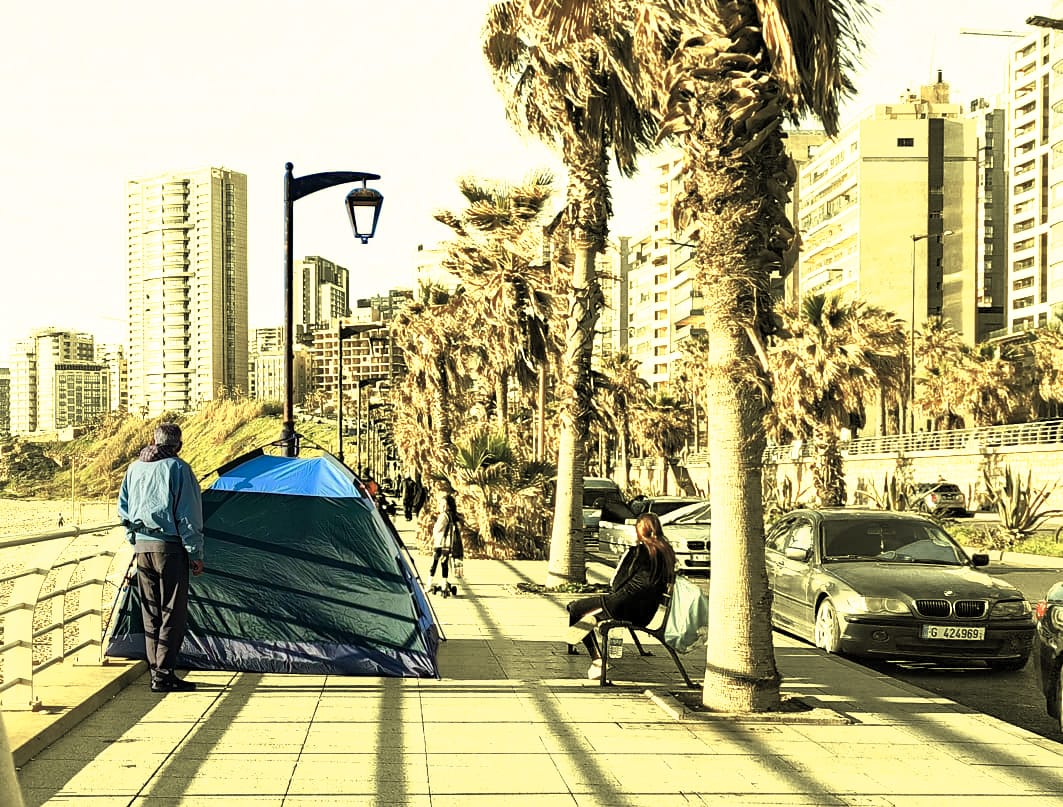
Hundreds of displaced families continue to seek shelter in public spaces, under difficult conditions, while other families are forced to negotiate or open vacant doors on their own to avoid sleeping in the open, amid rising housing costs, skyrocketing rent prices, and increasingly complex rental conditions. This situation is a direct result of shortcomings in the government’s plan to shelter the displaced, whose numbers continue to grow as the war intensifies and Israel issues repeated evacuation orders for cities and towns – particularly after 8 April, when Israel carried out widespread massacres across the country.
We urge the government not to repeat the mistakes of the 2024 emergency plan, starting with the absence of public transportation to meet the needs of displaced people fleeing the bombardment, the lack of clear instructions on how to reach shelter centers, and the failure to equip these centers to make them suitable for habitation and daily life. The 2024 plan did not provide clear steps for coordinating between shelter centers or directing people to them based on their capacity, nor did it address the needs of persons with disabilities and the elderly. It also excluded non-Lebanese and concentrated shelter centers in certain areas to the exclusion of others. Finally, the plan failed to address public spaces and their role in relief and shelter operations, state-owned properties and their availability, vacant properties and their conversion – even temporarily – into shelter centers, or the option of rent control, as rent prices have risen alarmingly.
Based on this, we, as civil society organizations, call for the following measures to ensure an effective response to the escalating emergency crisis, in light of evolving security conditions and the need to guarantee the right to housing – a right being violated on an unprecedented scale during war. In this regard, we also call for the declaration of a “state of general mobilization” pursuant to National Defense Law 102/1983, similar to what occurred during the COVID-19 pandemic. General mobilization enables the state to mobilize all human and material resources to serve the public interest and address the existing threat.
We are in urgent need of these interventions in the face of a complex and multifaceted crisis that is no longer limited to the issue of displacement alone, but encompasses the broader humanitarian, economic, and social crisis, along with the accompanying deterioration of infrastructure and basic services. Addressing this crisis as a comprehensive emergency requires moving beyond piecemeal and temporary responses and transitioning toward a sustainable strategy that reactivates the role of the state and strengthens its capacity to respond and recover in the long term.
1- Increasing, diversifying, and equipping shelter centers in an inclusive manner, and ensuring their balanced distribution
Designated shelter centers face major challenges in managing displacement, with many having reached maximum capacity and lacking readiness to accommodate diverse needs. Displaced people often arrive at centers that were already full before their arrival, or that are not equipped to accommodate the elderly and persons with disabilities, after having traveled long distances to reach them. Moreover, these centers are not distributed evenly across regions and neighborhoods, placing pressure on infrastructure in certain areas over others. Consequently, the number of these centers must be increased, they must be properly equipped, and their distribution must be balanced across different neighborhoods and regions.
They must also be diversified. The primary reliance remains on educational institutions, which raises multiple issues regarding the sustainability of using these facilities in the context of prolonged crises. The experience of 2024 showed that even after a ceasefire was declared, people were unable to return to their homes due to the destruction, forcing them to vacate shelter centers and turn to the high-cost rental market. This points to the need to activate a range of options, such as utilizing vacant public and private buildings (as highlighted in the following points) and establishing shelter centers on vacant land using sustainably designed temporary units that provide safe and adequate housing.
Special attention must be paid to ensuring that all shelter centers are inclusive and accessible to all affected residents, regardless of nationality or legal status. During previous escalations, migrant workers and non-Lebanese individuals were often effectively excluded from accessing shelter centers, leaving most without safe alternatives. Therefore, there is a need for clear guidelines, monitoring mechanisms, and accountability measures to ensure that shelter centers are open to everyone who needs them, and that access remains non-discriminatory, both in policy and in practice.
2- Directing displaced persons to shelter centers
Although the “Disaster Management Unit” issues periodic statements containing lists of approved official shelter centers, this information often remains inaccessible to displaced persons, as the channels through which it is disseminated are neither centralized, easily accessible, nor widespread. At times, some of this information reaches the public after being circulated on WhatsApp, while at other times it appears on scattered websites, yet remains inaccessible to groups already experiencing various forms of digital exclusion or limited internet access. This limits their ability to comply with complex administrative procedures or access information and their rights. As a result, displaced persons have been unable to access this information consistently and at all times, particularly those forced to remain on the streets and in public squares, which has hindered their access to such information and, consequently, to shelter centers.
Accordingly, any regulatory measures must take these structural disparities into account and must not lead to further marginalization or exclusion. Field guidance by municipal teams is an urgent necessity to ensure that people do not remain in the open. This includes, as a priority, conducting field visits, as well as strengthening the important role of Ministry of Social Affairs centers in areas that still do not receive displaced persons, to assist and guide them. In this context, clear information must be provided on available shelter options, and these options must be appropriate (i.e., responsive to people’s priorities) and feasible (in terms of transportation and sustainability).
3- Include vacant state-owned buildings in the housing plan and prepare them
In Beirut and various regions, Ministry of Finance data indicates the existence of thousands of properties owned by the Lebanese state, including municipal properties, properties of the Central Bank of Lebanon, properties of the Public Housing Corporation, and others.
Vacant state-owned properties across various regions in Lebanon that are suitable for use as temporary shelter centers must be made available. Examples include certain sites in administrative Beirut that could have been partially or fully equipped to receive displaced persons, such as the Mar Mikhael train station, buildings acquired for the Fouad Boutros highway project that were restored after the port explosion, the municipal stadium, and others. In a similar vein, buildings owned by religious endowments and institutions should be included so they can fulfill a social function, given that the government is able to exert influence at this level.
4- Including vacant privately owned buildings in the housing plan
The vacancy rate of apartments and buildings in Beirut, for example, has reached alarming levels (around 20%). During the 2024 war, due to the lack of capacity in official shelter centers, hundreds of displaced families moved into vacant buildings and turned them into temporary homes for the duration of the war. This occurred in at least 27 buildings identified in administrative Beirut, in addition to a number of buildings outside the capital, the vast majority of which were accessed through negotiations with their owners.
In the face of compelling circumstances such as war, this stock of vacant buildings could serve as an optimal solution for housing people, particularly seasonally used properties such as hotels, furnished apartments, chalets, and homes intended for summer and vacation use, in various areas not targeted during the war.
We call on the state to encourage the use of these buildings by negotiating with willing owners and offering them incentives (including, but not limited to, contracting with an organization to carry out partial renovations in a way that benefits the owner in the long term, with official authorities overseeing the contract and its implementation), and converting these buildings into shelter centers under the supervision of the relevant municipalities, which have the authority to identify vacant buildings, develop plans for temporary and safe housing within them, and negotiate with their owners.
Including this stock in emergency response plans acknowledges the city’s social function and contributes to providing faster and more dignified shelter for displaced persons.
5- Rent control to prevent exploitation
During the 2024 war, a significant proportion of displaced persons (approximately 28%) turned to renting as a means of securing shelter, a figure that may be lower than the actual number. Following the ceasefire, the number of displaced persons reached 64,417, 85% of whom lived in rented housing. However, prices were rising steadily. It is essential to regulate rents and establish fair rental values. This can be achieved through various mechanisms, including government decrees to regulate rents or set rent caps, or legislative measures extending all existing lease contracts at current rental rates for a specified period.
In this context, and in light of internal displacement, which places significant pressure on the rental market, maintaining housing stability for all has become an urgent priority. We therefore urge the government to support two rental proposals submitted by a number of members of parliament on 25 February 2026. The first is a repeated urgent bill to amend the old residential rental law, providing immediate protection for existing tenants, particularly those who were unable to benefit from the Tenant Support Fund and some of whom have faced eviction threats since 1 March. The second is a bill regulating new lease agreements, establishing clear controls on excessive rent increases and limiting the threat of arbitrary eviction.
6- Adopting a zero-eviction policy
Tenants must be protected from eviction, and effective mechanisms must be established to report rental-related violations, such as exploitation, discrimination, and arbitrary eviction, while ensuring oversight of landlords’ conduct.
Authorities must also protect occupants of vacant buildings and refrain from forcibly evicting them. The occupation of vacant buildings during the war is a common practice, particularly in Beirut, given the limited capacity of official shelter centers. In this context, public spaces must not be cleared without providing alternatives; any such action must involve relocating residents to alternative housing, rather than using force or intimidation.
Additionally, effective mechanisms must be established to report rental-related violations, such as exploitation, discrimination, and arbitrary eviction, while ensuring oversight of landlords’ conduct, including, but not limited to, court rulings ordering the eviction of long-term tenants without granting a grace period.
7- Adopting a discourse of solidarity and ensuring municipalities do not exceed their authority
The war phase requires the highest levels of social solidarity to unify the national spirit, free from any sectarianism or political exploitation. There is a need to adopt a discourse that reflects deep sentiments of solidarity and fraternity, thereby safeguarding the hosting of displaced persons from any sectarianism or political exploitation. It is also essential to mobilize the state’s available human resources for this purpose and to open the door to civilian volunteering within the framework of civil defense.
We recognize the need for municipalities to regulate housing for displaced persons, but we urge municipalities, their mayors, district governors, and provincial governors to adhere strictly to the powers and duties set out in the law, and not to exceed their authority by exercising powers that fall within the exclusive mandate of the judiciary or security agencies – particularly with regard to the eviction or raiding of homes, the sealing of shops with red wax, the requirement of prior approval for lease agreements, curfews, or security enforcement – without infringing on constitutional and legal rights. This should take place within a general policy established by the government or through a circular issued by the Ministry of Interior and Municipalities.
We also emphasize the obligation to respect the constitutional and legal rights of all individuals without discrimination, and to reject any sectarian or discriminatory practices that undermine the principles of equality and the rule of law. We believe that these issues must be addressed within a clear general policy established by the government, or through circulars issued by the Ministry of Interior and Municipalities, in order to ensure unified standards and respect for legal frameworks.
8- Allocating budget reserves to support displaced persons and strengthen tax collection
As in previous crises, the state is withdrawing from the scene and leaving responsibility for funding the displacement crisis and supporting displaced persons to international organizations, non-governmental organizations, and the general public, while external aid continues to decline.
Instead of waiting for uncertain and delayed donor support, there is a need to establish a long-term financial plan that prioritizes assisting civilians and ensuring their human dignity and shelter, in line with the state’s constitutional and legal responsibilities. In the short term, this requires mobilizing emergency resources, including the use of available central bank reserves, to cover urgent needs. In the long term, funding must come from strengthening tax collection. Public maritime properties remain effectively untaxed, as the approximately US$35 million recorded in the budget reflects a one-time settlement fee rather than a recurring tax on valuable coastal real estate. Quarries and crushers are also not subject to any sector-specific fees, while luxury goods remain exempt from any additional taxes beyond the standard value-added tax. Customs revenues also remain far below their true potential. Therefore, the government should prioritize strengthening tax collection, enforce Law No. 55/2016 to identify Lebanese residents earning income abroad and apply a 10% tax on income from movable capital, and consider introducing a temporary solidarity tax, based on historical precedents in Lebanon, to help finance the rising costs of displacement.
9- Improving the quality, coverage, adequacy, and sustainability of humanitarian and social assistance
Learning from past crises, including the previous war, requires improving the quality, coverage, adequacy, and sustainability of humanitarian and social assistance, while building on the progress achieved in Lebanon’s aid system. This includes opening lines of credit and allocating additional resources to support those affected, developing financial mechanisms to facilitate the transfer of funds to social safety nets and disability allowances, and expanding these networks vertically to improve the value of assistance and horizontally to include non-beneficiaries through new registration platforms. It also requires the adoption of emergency decrees to direct budgets toward a unified safety net, enhancing data sharing and coordination with humanitarian organizations to avoid parallel systems, establishing a coordinating body to ensure an integrated response, and activating a unified and sustainable mechanism for receiving and addressing complaints to strengthen transparency and accountability.
In the medium and long term, this requires implementing the National Strategy for Social Protection and the Pension Law, as well as investing in the development of social safety nets to ensure their integration into a comprehensive social security system capable of responding to crises.
In conclusion, this is not the first war experienced in Lebanon, but this war differs from previous ones in its intensity and the scale of ongoing displacement, which will result in a catastrophic humanitarian and social crisis if the state does not intervene at multiple levels to organize shelter.
We believe that failing to address the shelter crisis in a comprehensive and equitable manner contributes to the exacerbation of social and political tensions. On the contrary, addressing these issues in a fair and organized manner would help mitigate divisions and support the resilience of the population and the preservation of their dignity, in the context of a devastating war that has lasted for more than two years.
Signatories:
Public Works Studio
Arab Reform Initiative
The Policy Initiative
Anti-Racism Movement
Gharbal Initiative
Jibal
Socio-Economic Working Group (Siyaq)
The Agricultural Movement in Lebanon
Seed in a Box
Lebanese Center for Human Rights
LUPD
Popular Coordination Committee

Beirut, the Confiscated City:
From Privatizing the Waterfront to Expelling the Displaced
This commentary examines Decree No. 5665/1994, which transferred approximately 291,800 square meters of reclaimed public maritime land in central Beirut to Solidere as part of the post-war reconstruction process. It revisits the decree ...