
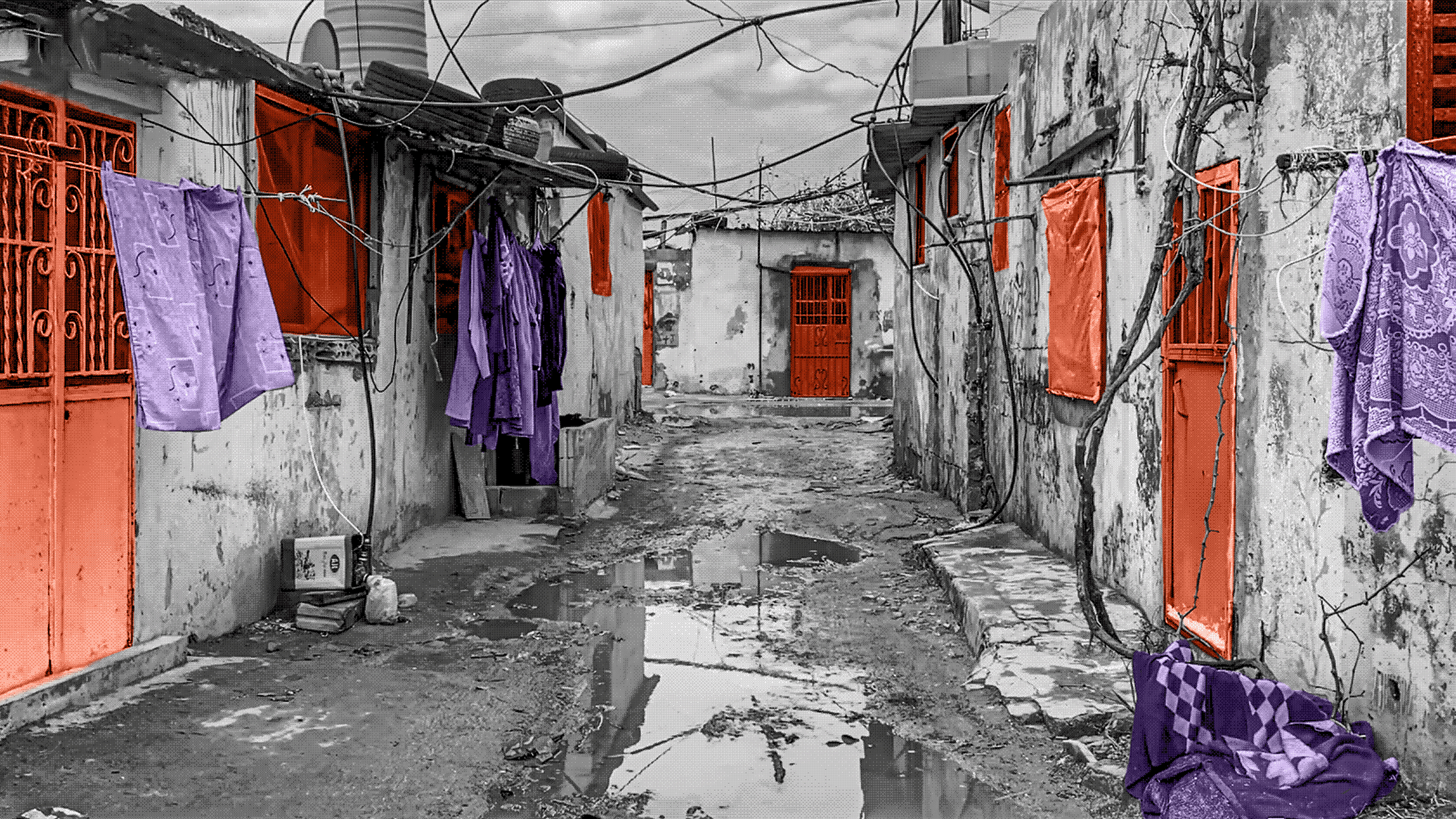
Late last year, as Tripoli entered its cold season, something unsurprising occurred: Hayy el Tanak neighborhood entered a new phase of displacement when fifteen families found themselves evicted from their homes.
Those evicted were not newcomers or trespassers; they were workers and their families who had lived there for many years in homes that were built gradually, on a forgotten plot of land they had transformed into a neighborhood in the truest sense of the word. But when the time came, what had been built was seen only as an obstacle to be removed, as if what had been constructed was nothing but an assault on the city’s future.
What happened can only be interpreted as a stark condensation of the city’s logic when it looks down on its inhabitants from above, like examining a map on a cold table. A city that allows people to live in tin shacks, provided their existence remains without horizons, and that their lives are not permitted to advance even a single step. Hence, this article sees Hayy el Tanak not as an example or proof of randomness or disorganization, but rather as a question about the meaning of a neighborhood; for the neighborhood is not a product of chance or an architectural sin. It is, in fact, a testament to the architecture of exclusion.

