
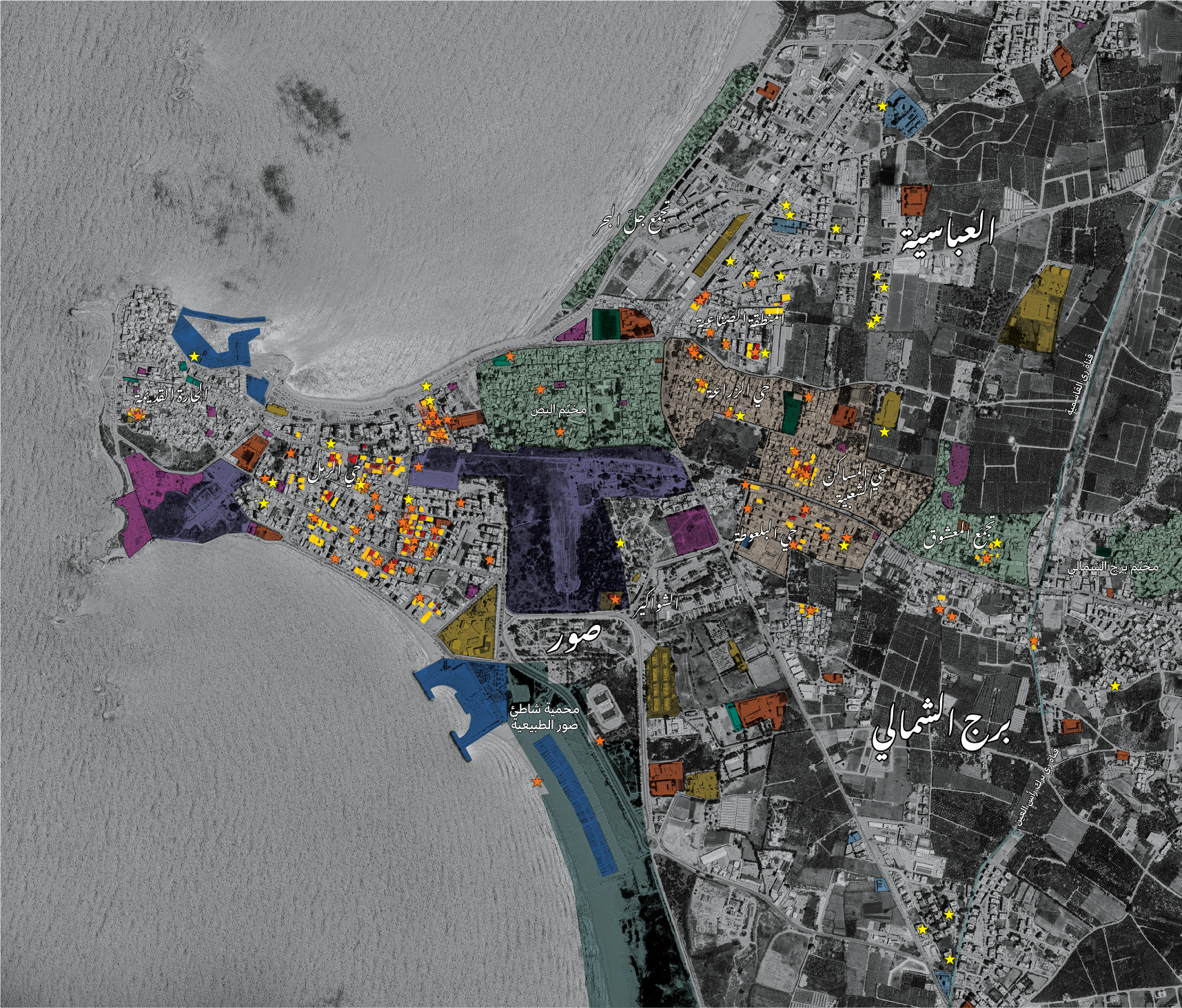
Extracted from a wider research conducted by Public Works Studio, this article provides an analysis of the Israeli aggression against Tyre City between October 2023 and April 2026, framing it as a systematic process of “urbicide” that stands in contrast to the more localized damage of 2006’s war.
The article highlights the use of “collective evacuation warnings” issued by the Israeli military, arguing that these are colonial tools of terror that reduce the city to abstract military targets while ignoring its lived reality. In Greater Tyre, these orders have recently covered 24.3km2, causing displacement and threatening over 19,000 buildings, including vital religious, cultural, educational, and healthcare facilities.
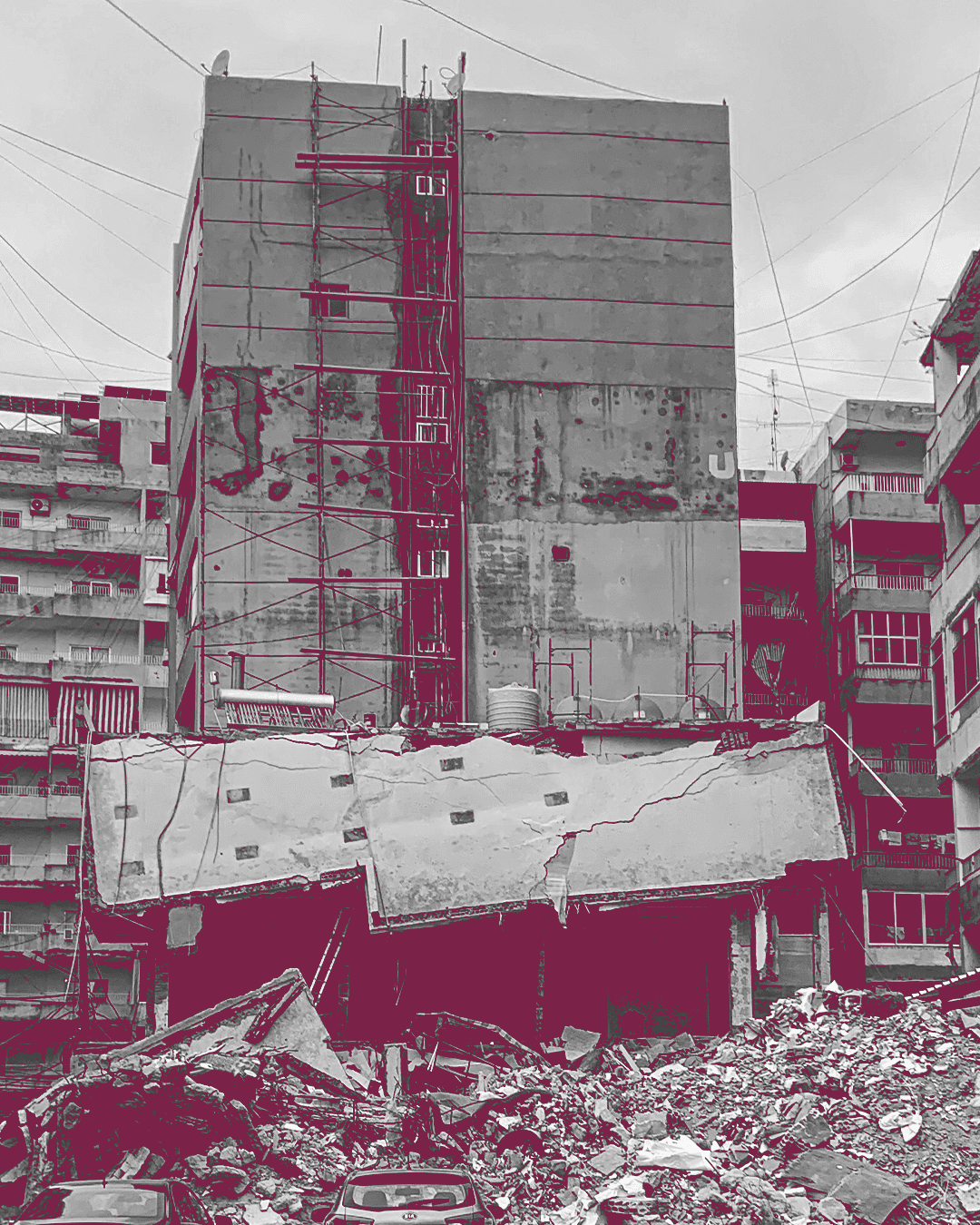
Beyond the warnings, the article documents the physical toll on the urban fabric. Field surveys conducted by Public Works Studio identified 79 buildings completely destroyed and 166 partially damaged by mid-2025 alone. Spatial analysis reveals that the dense Al-Raml neighborhood suffered the most significant destruction, while the deliberate targeting of residential “clusters” across the city has fragmented the multi-generational family networks and social ties that define Tyre’s social identity. This destruction extends to the city’s economic hubs like Abu Deeb Street, where the “live-work” urban model means families often lose both their homes and their livelihoods in a single strike.
Furthermore, the article highlights a critical legal vulnerability: as significant destruction sits on state-owned (Amiri) land—including informal neighborhoods and Palestinian camps—residents without formal deeds face a risk of permanent displacement under the pretext of “illegality.” Ultimately, the article advocates for a future “Just Recovery Policy” that moves beyond mere physical reconstruction to prioritize return, social cohesion, the protection of local economic structures, and the establishment of flexible legal frameworks that secure the residents’ fundamental “Right to the City.”
This article was produced as part of the project “Participatory Workshops towards Recovery Pathways in Tyre and South Beirut” in which the residents of Tyre and the Green Southerners were partners in producing its outputs. This path was implemented within the framework of a joint project in collaboration with The Policy Initiative (TPI), Beirut Urban Lab at the American University of Beirut, and Legal Agenda, with support from the International Development Research Centre (IDRC).
Read the full article in Arabic.



Solutions to Adapt to the Conditions of War: A Temporary Fix that Conceals the Necessity of Reforming Property and Construction Laws.
A Joint Commentary by Public Works Studio and Legal Agenda
The proposed draft law, submitted on November 19, 2024, suggests extending the validity of Law 294/2022 for five more years and applying some modifications to certain clauses. The law is proposed with the …